
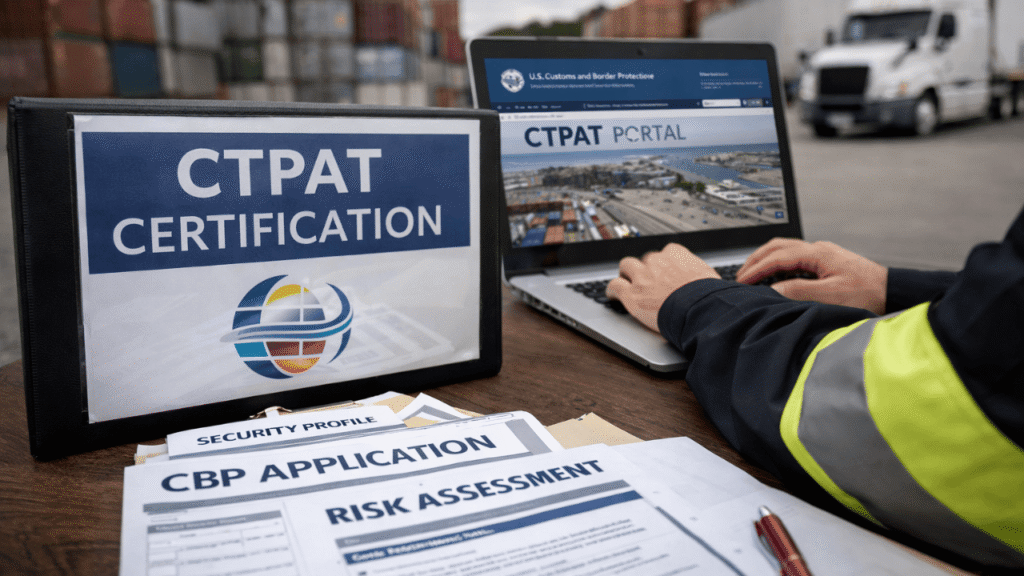
If your business ships across U.S. borders, you know how expensive it can be to wait and be inspected. Getting CTPAT certification is one of the smartest things you can do right now. It’s a voluntary program that puts your business in the U.S. The trusted trader list from Customs and Border Protection. Less checking at ports. Clearances that happen faster. Better relationships with business partners. Does that sound good? This CTPAT certification guide will show you how to do it step by step.
Table of Contents
What Is CTPAT and Why Does It Matter?
CTPAT stands for the Customs-Trade Partnership Against Terrorism. It’s a partnership between the public and private sectors that aims to make international supply chains stronger and make the U.S. border safer. When you join, you agree to work with CBP to identify security holes and implement real protections.
More than 11,400 certified partners, such as importers, exporters, carriers, customs brokers, and freight consolidators, account for more than 52% of the value of cargo brought into the U.S.
There are real benefits. Members get access to the FAST Lane, fewer CBP inspections, and a dedicated point of contact at CBP. Also, supply chain safety improves across the board, helping keep your business safe from cargo theft, smuggling, and other threats.
Who Can Apply?
You need to ensure your business is eligible before you can obtain CTPAT certification.
Businesses involved in the importation, transportation, or handling of goods into the United States are eligible. This includes people who bring goods into the country, send them out, make them, move them, combine them, work as licensed customs brokers, and run warehouses.
Companies based in the U.S. and some in Canada and Mexico that meet the requirements can apply for CTPAT membership.
CTPAT Certification Guide: Step-by-Step Guide to Getting CTPAT Certification
This CTPAT certification guide walks you through the entire certification process from start to finish.
Step 1: Review the Minimum Security Criteria
Don’t miss this step. The first thing your business needs to do is check the CTPAT Minimum Security Criteria for your type of business to see if you qualify.
The security criteria include checking the people who work for you, ensuring your IT systems are secure, and ensuring your procedures are followed. Before you apply, you need to do a gap analysis of your company’s current policies and practices against these minimum security standards. You can do this yourself or hire someone else to do it.
Step 2: Conduct a Risk Assessment
As part of the CTPAT application process, you must do a full risk assessment.
This includes mapping the flow of your cargo and data, identifying all your business partners, assessing threats such as terrorism, smuggling, and human trafficking, and evaluating the conditions in the countries or regions that make up your supply chain.
Write down everything. CBP wants to know that you did more than fill out a form.
Step 3: Submit Your CBP Application Through the CTPAT Portal
You can now submit your CBP application online after completing your gap analysis and risk assessment.
You can apply online. A company representative completes the application on a secure website called the CTPAT Portal. The Company Profile and the Security Profile are the two parts.
The company profile includes basic information such as addresses, contacts, and its organizational structure. When you submit the company profile, an account is created in the CTPAT Portal. After that, you’ll go to the Security Profile section, which has more information.
Step 4: Build Your Security Profile
Take your time with this because it’s the most important part of your compliance program, and a strong CTPAT certification guide always starts with a strong security profile.
You need to create and follow a security profile that demonstrates how you meet or exceed CTPAT’s minimum security standards, based on your risk assessment findings. This part of the CTPAT certification guide is critical because CBP reviews it closely.
Your profile should cover how you keep your employees safe, protect your IT systems, check the backgrounds of your employees, and handle goods at every stage of the supply chain. Companies seeking CTPAT certification must also have a policy that complies with CBP rules against forced labor.
Take your time with this. The most common reason for applications to stop working is a weak security profile.
Step 5: Sign the Memorandum of Understanding (MOU)
The last step in the first application process is to read and fill out the Memorandum of Understanding. The MOU spells out what your company and CBP are responsible for and what they agree to. Read it carefully. If there are any mistakes, your application may be denied or take longer to process. Once you sign the MOU, your business is bound by its terms.
Step 6: Wait for CBP Review
CBP reviews your materials after you complete the application and supply chain security profile. The evaluation takes 30 to 60 days after you submit the security questionnaire, and CBP has up to 90 days to approve or deny the application.
Be responsive during this time. If CBP asks you something, answer it quickly and fully.
Step 7: Complete the Validation Visit
If CBP accepts your application, the next step is to validate it.
A Supply Chain Security Specialist will call you to schedule a visit to your locations to assess how security is handled there. Your business becomes a Tier II company and starts receiving all the benefits of the CTPAT program once the specialist determines that your operations meet CTPAT standards.
If the company gets certified, it will remain valid for a year.
How to Make Your Application Stronger
- Get support from leaders early on. Getting help from upper management from the beginning makes the certification and ongoing maintenance processes go more smoothly and quickly.
- Make sure your written rules are easy to understand. CBP wants to see that you have written down, followed, and used the same security measures at all of your locations.
- Teach your team. Everyone, from the IT people to the people who work in the warehouse, needs to know how to keep the supply chain safe.
- Be consistent. After you pass, keep doing everything the right way. Every three years, CBP checks on you again.
Ready to Get CTPAT Certification?
Now is the best time to get CTPAT certification if you really want to protect your supply chain and speed up border crossings. It takes dedication to do the process right. You need to conduct a thorough risk assessment, create a detailed security profile, and be willing to keep your practices sharp over time. But the benefits are real: fewer inspections, faster shipments, and a competitive edge that shows your partners you care about supply chain safety.
The first step is to go to the CBP’s CTPAT Portal and conduct an honest gap analysis. Use this CTPAT certification guide as a reference while building a security profile that reflects how your business really operates.
Need Help Getting Started?
Reach out to us at www.welocity.ca, call 905-901-1601, or email info@welocity.ca if you need help with trucking-related services. Whether it is compliance support, operational guidance, or documentation help, we are ready to support your team.