
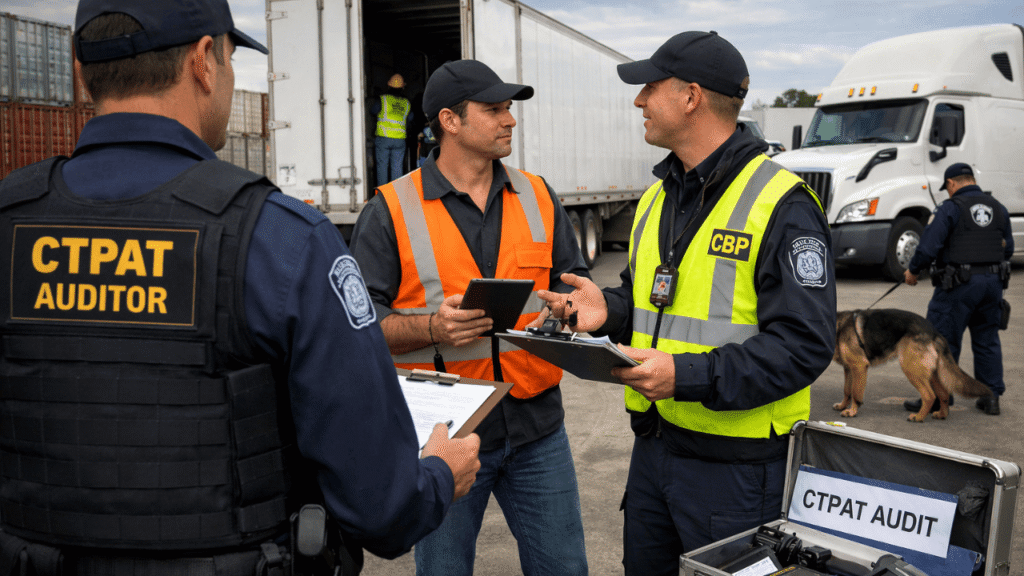
If your business brings goods into the United States, one of the best ways to protect your supply chain and reputation is to pass a CTPAT audit. Knowing exactly what CBP wants makes a big difference, whether you’re getting ready for your first validation or your second.
This guide tells you everything you need to know to feel sure that you can pass a CTPAT audit.
Table of Contents
What Is a CTPAT Audit and Why Does It Matter?
A CTPAT audit assesses the safety of your company’s supply chain. The Customs-Trade Partnership Against Terrorism (C-TPAT) program, which is run by U.S. Customs and Border Protection (CBP), does this work.
More than 11,400 certified CTPAT partners will be responsible for 52 percent of the value of all cargo entering the United States by July 2025. That’s not a niche program; it’s where serious supply chain managers compete.
Getting through the CTPAT audit gives you real benefits, like getting through customs faster, fewer inspections, and a direct line to a CBP Supply Chain Security Specialist (SCSS) who helps you follow the rules.
How to Pass a CTPAT Audit Successfully
The short answer is? Preparation, documentation, and consistency. Here’s how to make a plan that really works.
1. Understand the Minimum Security Criteria (MSC)
First things first, you should know what CBP is looking for. To get CTPAT certification, you need to meet minimum security standards in four main areas: Corporate Security, People Security, Physical Security, and Transportation Security.
The CTPAT compliance checklist is a set of 13 rules that U.S. Customs and Border Protection (CBP) has established to help businesses demonstrate that their supply chain is safe from threats such as terrorism, theft, smuggling, and forced labor.
Take your time reading the MSC. Before your audit readiness review starts, you should know it inside and out.
2. Get Your Documentation in Order
This is where most businesses go wrong. When CTPAT validations fail, auditors typically see only 7 to 10 total documents uploaded to the portal. This is usually not enough for CBP to consider acceptable. To reduce the risk of rejection, there should be about 35-40 written documents in total.
Your CTPAT audit documentation package should have:
- Security policies and procedures that are written down
- Records of the layout of the facility and access control
- Logs of inspections of containers and vehicles
- Records of employee training that include names, dates, and curriculum
- Filled out security questionnaires from business partners
- A risk assessment that has been written down and updated in the last year
It will help a lot to carefully review the CTPAT security profile to ensure it is correct and complete, including all necessary information and documents. Making videos, photos, and written records of key parts of the building will also help with validation.
3. Conduct a Thorough Risk Assessment
Your risk assessment is a big part of CBP’s commitment to trade compliance. Partners in CTPAT must do risk assessments at least once a year.
The C-TPAT Five-Step Risk Assessment Guide helps members conduct thorough risk assessments to manage supply chain risks better. This process includes mapping your cargo’s flow, listing all your business partners, identifying potential threats by country, and ranking your weaknesses.
During the security audit, your SCSS will likely ask many questions about this process. Know your answers by heart.
4. Strengthen Physical and Cybersecurity Controls
A full CTPAT audit checklist includes physical access controls (ways to prevent unauthorized entry into buildings, such as gates, fences, locks, and identification systems) and container and conveyance security (ways to keep containers safe, such as proper sealing and inspections).
CTPAT members must have detailed, written cybersecurity policies in place to protect their IT systems. These policies should include anti-virus software, regular updates to security software, and rules and procedures to stop social engineering.
Don’t put off thinking about cybersecurity. Now, CBP inspection teams pay close attention to it.
5. Train Your Team and Document It
5. Teach your team and write it down.
You need to show that your employees know your security rules. You should bring a training log to the meeting that lists the names, dates, and curriculum for the required training.
Your SCSS will also want to ensure you have a good way to share training and SOPs with your business partners, since they need to know about your CTPAT protocol.
Training is more than just a box to check. This shows that your security culture is real.
6. Screen and Monitor Your Business Partners
An audit by CTPAT doesn’t end at your front door. Business partners are all the companies with which the CTPAT member works, including foreign suppliers, U.S. domestic carriers, carriers in the countries of origin, customs brokers, and freight forwarders.
Questionnaires alone shouldn’t be used to check for compliance. On-site supply chain security audits, tailored to risk, should also be conducted.
Send out security questionnaires regularly, follow up on any gaps, and keep track of all interactions.
7. Stay Current on Forced Labor Requirements
This is something many businesses don’t pay attention to, but it’s become a major part of audit compliance reviews. The forced labor requirements added in November 2022 completely changed CTPAT compliance. CBP now wants you to identify risk points in your supply chain, train your suppliers on your standards, and watch for warning signs such as inconsistent paperwork, low labor costs, and high employee turnover.
Companies that don’t keep up with these changes often lose their certification during revalidation. Ensure your code of conduct and supplier due diligence documentation are up to date.
What Happens During the CBP Inspection?
CTPAT participants receive about 30 days’ written notice in advance, along with a request for any documents that may be needed.
The validation team assesses the status and effectiveness of the participant’s profile’s most important security measures, making suggestions and highlighting best practices when they see them.
Be ready. Designate a point of contact who knows the program inside and out, and ensure all key team members are available during the review.
After the CTPAT Audit: Keep the Momentum Going
The CTPAT audit is not the end; it is the beginning. After you get certified, you have to revalidate every 4 years and send in Annual Notification Letters stating that there have been no major changes to your business.
The CTPAT point of contact needs to be well-versed in the program and keep upper management informed about audits and validations.
Always make it a habit to try to get better. Check your security profile regularly, update your risk assessment once a year, and never think of compliance as something you can do and forget.
Be Ready for Your Next CTPAT Audit
The CTPAT audit process can seem like a lot of work, but it doesn’t have to be. Get your paperwork in order early, break it down into steps, train your staff, and involve your business partners. CBP checks your real practices, not just the papers you send them.
Companies that see the CTPAT audit as an ongoing commitment, not just a one-time problem, are the ones that pass every time, build stronger supply chains, and gain the trust that comes with certification.
Get ready today, and you’ll be in a much better place when the validation notice comes.
Need Help With CTPAT Preparation?
Reach out to us at www.welocity.ca, call 905-901-1601, or email info@welocity.ca if you need help with trucking-related services. Whether you need compliance support, documentation guidance, or operational preparation, we are ready to help.