
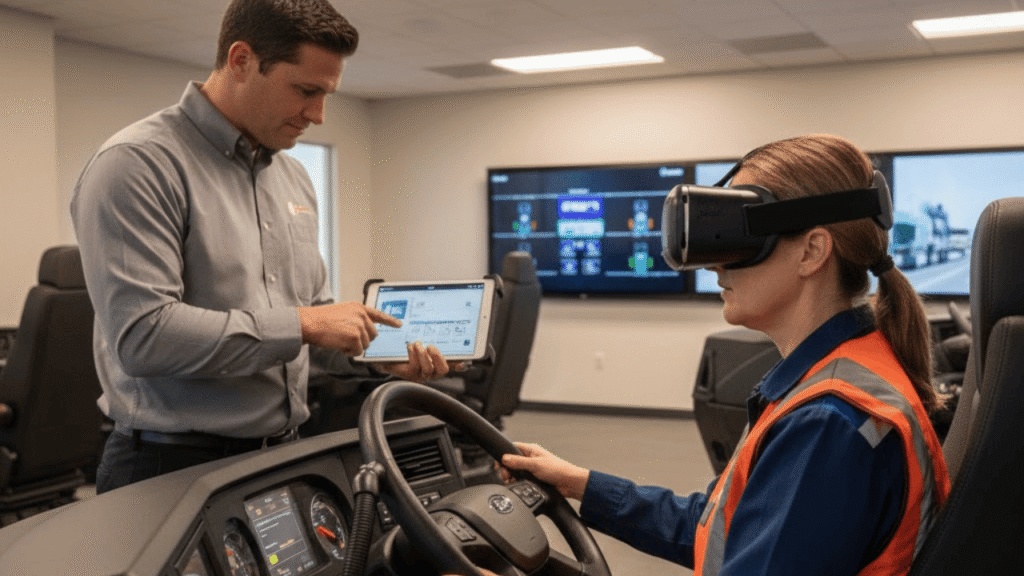
VR driver training for trucking is quickly moving from “nice-to-have” to a practical tool fleets use to coach high-risk situations, without putting people, equipment, or freight in danger. Instead of trying to recreate a blowout, a skid on black ice, or a pedestrian darting into traffic in the real world, fleets can train those moments safely in a headset or simulator cab.
That said, VR isn’t replacing road time. The best programs blend simulation-based driver training with behind-the-wheel practice, coaching, and ongoing refreshers.
Table of Contents
What Is VR Driver Training for Trucking?
VR driver training for trucking uses virtual reality headsets (and sometimes a simulator cab with controls) to place drivers inside realistic driving scenarios.
Common uses include:
- Hazard perception and space management
- Speed and following-distance decisions
- Adverse weather and low-visibility driving
- Backing, docking, and yard awareness
- Distracted-driving and fatigue risk scenarios
Because the environment is controlled, trainers can repeat the same scenario, score performance, and provide targeted feedback, key benefits of immersive learning for drivers.
VR CDL Training: What It Can (and Can’t) Do
If you’re thinking about VR CDL training, one important rule applies in the U.S.: FMCSA guidance says simulators cannot substitute for required behind-the-wheel (BTW) training under Entry-Level Driver Training (ELDT). Simulators may be used in theory training, but not to meet BTW requirements.
So, VR can help trainees build confidence and decision-making before they get on the road, just don’t treat it as a compliance shortcut.
Why Fleets Are Adopting Truck Driving Simulator Training
Safer practice for high-risk events
Virtual scenarios let drivers practice rare but dangerous events (like sudden cut-ins or low-traction braking) without real-world consequences, making virtual reality safety training especially valuable for risk reduction.
Faster feedback and more consistent coaching
Simulations capture repeatable performance data (reaction timing, scanning patterns, speed control). That supports coaching that’s specific, fair, and measurable.
Better training engagement
Many fleets report stronger participation when training feels interactive instead of lecture-based. That’s a major win for rolling out training engagement strategies across terminals and shifts.
Does Simulation-Based Driver Training Actually Work?
Research across driving simulators generally finds improvements in driving skills and behavior, especially when training is structured and reinforced.
In trucking-specific research, ATRI reported early evidence that targeted simulator training was associated with fewer safety incidents at 6 months, with effects fading by 12 months, highlighting the importance of refresher (“sustainment”) training.
Best Practices for Implementing Immersive Learning for Drivers
1) Start with the job’s highest-risk moments
Prioritize scenarios tied to your incident history (backing collisions, speed-related events, winter ops, intersections).
2) Blend VR with coaching and road time
Use VR to build mental reps, then validate on-road with a trainer. Think: learn → practice → coach → refresh.
3) Keep sessions short and frequent
10–20 minute modules often work better than long blocks, especially for experienced drivers who value efficiency.
4) Build a coaching loop
After each simulation:
- Replay the scenario
- Ask what the driver noticed
- Align on the safest decision
- Set one improvement target for the next run
5) Plan for real-world constraints
Account for:
- Motion sickness and comfort settings
- Equipment cleaning/sharing procedures
- Scenario realism (cab controls vs. headset-only)
- Data privacy and performance transparency
Where VR Training Is Headed for Trucking Fleets
The future isn’t “VR versus real driving.” It’s VR driver training for trucking used as a smarter front-end to behind-the-wheel training, plus ongoing refreshers that keep skills sharp. Fleets that treat VR as part of a continuous improvement system (coaching, metrics, sustainment) are the ones most likely to see long-term safety gains.
Related Article: The Future of Trucking Training Technologies
Make VR and Simulator Training Work in the Real World
Want to modernize training without losing practicality or compliance focus? Reach out to us at www.welocity.ca, call 905-901-1601, or email info@welocity.ca for trucking-related services like ELD setup, compliance training, safety coaching, and vehicle inspections, so your training program stays effective on paper and on the road.