
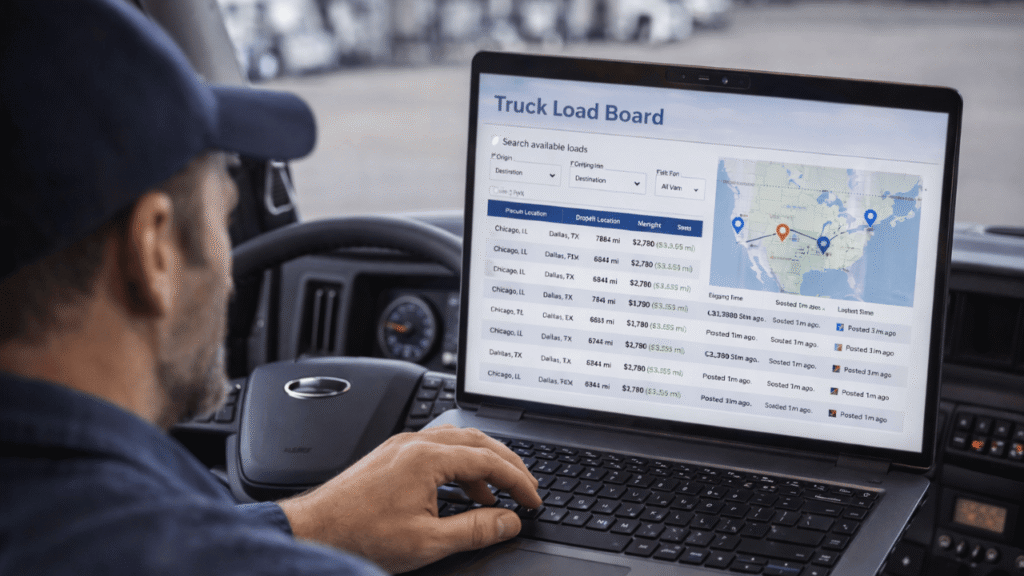
Truck load board remain an important tool for independent drivers. Whether you’re new to the industry or running under your own authority, mastering load board tips for owner-operators can dramatically improve your income and reduce wasted miles.
This guide breaks down practical strategies to help you search smarter, avoid common pitfalls, and negotiate better spot market rates.
Table of Contents
Understand How Truck Load Boards Really Work
Load boards are marketplaces where brokers and shippers post available freight. Rates fluctuate constantly based on supply, demand, seasonality, and location.
Before booking loads, understand:
- Rates change by the hour, not daily
- High-paying loads move fast
- Cheap freight often signals urgency or poor planning
Owner-operators who treat load boards as data tools, not just booking platforms, gain a competitive edge.
Use the Best Load Board Search Strategy
The best load board search strategy focuses on efficiency and profitability, not just rate per mile.
Search smarter by:
- Filtering by pickup time instead of price alone
- Prioritizing lanes with strong reload potential
- Avoiding areas known for poor outbound freight
Saving 50 empty miles can be more profitable than chasing a slightly higher-paying load.
Master Rate Per Mile Calculation
Many drivers fall into the trap of booking loads based only on total payout. Rate per mile calculation gives a clearer picture of profitability.
Always calculate:
- Linehaul rate per mile
- Deadhead miles before pickup
- Fuel cost by region
A load paying $2.40 per mile with minimal deadhead often beats a $3.00 load that requires long unpaid repositioning.
Rule of thumb: If you don’t calculate it, you can’t control it.
Spot Market Load Booking Timing Matters
Spot market load booking is as much about timing as it is about pricing.
Helpful timing tips:
- Early morning: more options, lower urgency
- Late afternoon: fewer loads, but more negotiation power
- End of week: brokers often need trucks fast
Knowing when to call can help you negotiate load board rates more effectively.
Learn How to Negotiate Load Board Rates
Most posted rates are not final. Negotiation is expected.
When negotiating:
- Lead with your target rate confidently
- Mention current lane demand or limited capacity
- Be polite, professional, and concise
Avoid overexplaining or justifying every dollar. Strong, calm communication signals experience and reliability.
Avoid Freight Scams on Load Boards
Freight scams are a real risk, especially for new owner-operators. Learning how to avoid freight scams protects both your income and authority.
Red flags include:
- Brokers unwilling to provide MC or DOT details
- Requests to reroute after pickup without paperwork
- Rates far above market with rushed instructions
Always verify broker credentials and confirm load details in writing before moving freight.
Build Lane Familiarity Over Time
The most successful owner-operators don’t chase random freight, they specialize.
Benefits of lane familiarity:
- Better rate expectations
- Faster decision-making
- Stronger broker relationships
Over time, knowing which lanes pay consistently helps you book with confidence and reduce stress.
Turn Load Boards Into a Profit Tool
Using the right load board tips for owner-operators transforms load boards from a guessing game into a strategic advantage. With smart searches, accurate rate calculations, strong negotiation skills, and scam awareness, you can book better freight and protect your bottom line.
Need Help Improving Your Owner-Operator Strategy?
Reach out to us at www.welocity.ca, call 905-901-1601, or email info@welocity.ca. Whether you need compliance support, ELD setup, or operational guidance, Welocity is here to help you succeed on the road.