
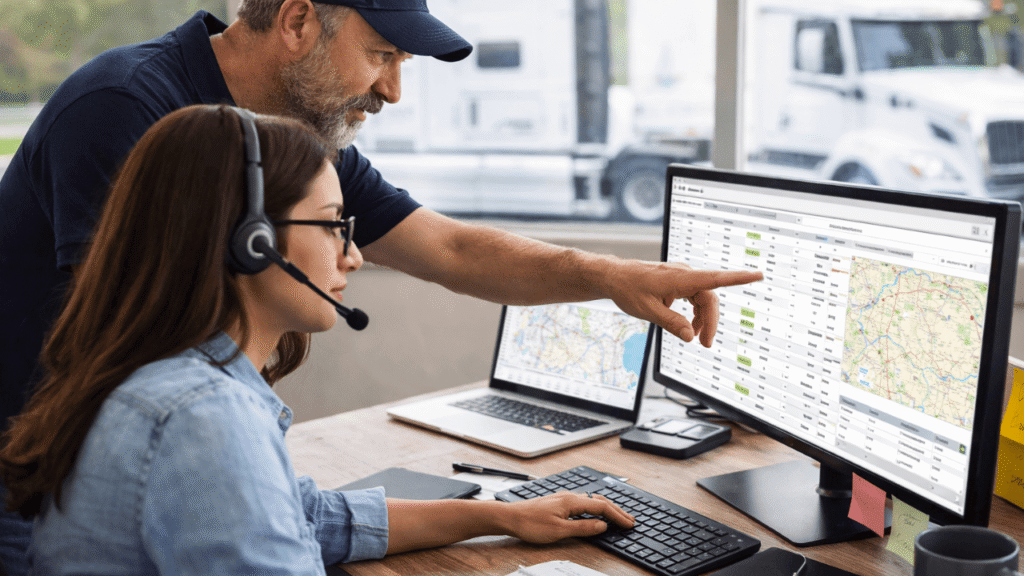
About 87% of freight in the US moves by truck. A dispatcher makes sure that every loaded truck on the highway has a place to go. Truck dispatcher training could be what you need if you want to work in logistics but don’t have a CDL or a college degree. The job is in high demand, the start-up costs are low, and you can do it from home. But it’s a big mistake to jump in without getting ready.
This guide tells you everything you need to know, from what dispatchers do to how to get trained, find clients, and start a career from scratch.
Table of Contents
What Does a Truck Dispatcher Do?
The dispatcher is the most important part of any carrier’s business. You are the one who connects drivers with freight, takes care of the paperwork, and makes sure that deliveries happen on time. That means:
- Finding and reserving loads on load boards
- Talking to freight brokers about rates
- Telling drivers when and where to pick up and drop off
- Taking care of rate confirmations, bills of lading, and invoices
- Fixing things when they go wrong, which they always do
A truck dispatcher helps plan, carry out, and keep an eye on long-distance and local deliveries to make sure they arrive on time and without any problems. It’s a job that requires good communication skills and the ability to stay calm under pressure. That being said, if you have experience in customer service, administrative work, or logistics support, you’re closer to being ready than you think.
Truck Dispatcher Training for Beginners: Where to Start
You don’t need a license to be a dispatcher, but that doesn’t mean you don’t need training. Taking a focused course is the best way to get hands-on experience and learn how to dispatch quickly. People sometimes call these “freight dispatcher training” programs, and they usually only take a few days or weeks to finish. A good training program for truck dispatchers should include:
- How load boards like DAT and Truckstop work
- Freight terms include BOLs, rate confirmations, detention pay, and deadhead miles.
- How to talk to brokers about rates
- FMCSA rules and Hours of Service (HOS) rules
- Setting up contracts and onboarding carriers
- Not just theory, but real-life dispatch situations
Look for classes that cover important topics like load board navigation, carrier onboarding, legal and compliance training, and real-world simulations, dispatch scenarios that mimic everyday problems like driver delays, missed pickups, or last-minute rate negotiations.
In addition to taking formal classes, you can gain experience by working as an apprentice, in an entry-level job, or as a mentor with experienced dispatchers to solve real-world problems. When you’re just starting, free resources like YouTube tutorials, Facebook groups for the trucking industry, and trucking forums, are also very helpful.
Important Skills You Will Need
- It’s not just about learning how to use software in truck dispatcher training; it’s also about getting a certain set of skills that will help you do your job well.
- Communication. Dispatchers are the main people who help clients, suppliers, and truck drivers talk to each other without any problems. Fleet, you’ll be on the phone all the time, so it’s important to be clear and professional every time.
- Time management. You might be dealing with five loads, three drivers, and a broker who won’t stop calling all at once. Staying organized isn’t a choice; it’s a matter of life and death.
- Problem-solving. Things break down. Delays in the weather happen. Drivers call in sick. Dispatchers who do a good job should know how to use ELD systems, combine route optimizers, and follow rules like the FMCSA Hours-of-Service rules.
- Negotiation. To get your carrier the best rate on a load, you need to know the market and be sure of yourself. This is a skill that gets better with practice, and good logistics training programs let you practice before you have to do it for real.
- Tech proficiency. Dispatchers use TMS, load boards, ELDs, and GPS telematics every day, so they need to learn how to use these tools in real life.
How to Get Started in Freight Dispatching: Step by Step
- Step 1: Learn the industry. Learn about freight terms, lane dynamics, and how load boards work. Use free resources first, and then pay for a structured course.
- Step 2: Set up your business. If you want to work for yourself, you need to set up an LLC, get an EIN from the IRS, open a business bank account, and write a dispatcher-carrier agreement before you start working with clients.
- Step 3: Get your tools in place. You will need access to a load board (DAT or Truckstop), a reliable computer, high-speed internet, document signing software like DocuSign, and accounting software like QuickBooks. Using the right dispatch software makes it easier to assign drivers and run your trucking business smoothly.
- Step 4: Find your first carrier. To get your first client, post in trucking Facebook groups, contact owner-operators directly, or offer a free trial at a lower price. Most new dispatchers start with one to three trucks and add more as they get better.
- Step 5: Book your first load. Look through the load board, call the broker, talk about the rate, get the rate confirmation signed, and tell your driver everything. Stay available during the entire haul and pick up the proof of delivery when it’s done.
What Can You Earn From Dispatching?
The income potential is real, and it grows. Entry-level dispatchers make between $40,000 and $55,000 a year as full-time employees. More experienced dispatchers who work with bigger fleets can make between $60,000 and $80,000 a year. Freelance and remote dispatchers usually make between $500 and $1,000 per truck per week. This means that managing four to eight trucks can bring in $4,000 or more a month.
Freelancing is especially good for people who see dispatching as a full-time job, not just a side job.
Start Your Truck Dispatcher Training and Build a Real Career
One of the easiest jobs in the logistics industry to get is as a truck dispatcher. Training is the first step. You don’t need a truck, a degree, or any experience. You need to know how to book loads, be able to communicate well, have the right tools, and be willing to keep learning as the industry changes.
Whether you aim to work as an independent dispatcher or as an in-house dispatch employee, the opportunities are immense for those who treat truck dispatching as a professional service.
Find a good training program, put in the time to learn the basics, and then take that first step. The need for skilled dispatchers isn’t going away, and neither is the freight industry.
Reach out to us at welocity.ca, call +1 905-901-1601, or email info@welocity.ca if you need trucking-related services. Whether it is business setup, compliance setup, cost planning, or fleet support, we are here to help you succeed from day one.