
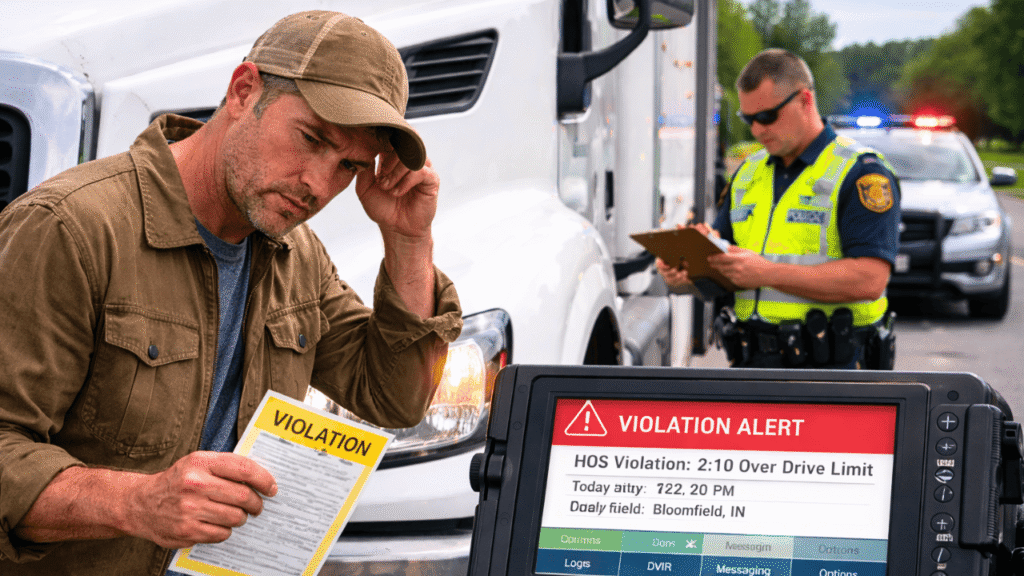
Most fleets think ELD trouble is “just a log issue.” Then the real costs show up, missed appointments, dead miles, angry customers, and drivers sitting when they should be moving. That’s the impact of ELD violations in the real world. It’s not only what happens at the scale house or roadside. It’s what happens after the violation when your operation starts bleeding time and money.
If you’re trying to run a tight ship, the impact of ELD violations can quietly wreck your weekly numbers, especially when the same problems repeat across multiple drivers or lanes.
Table of Contents
how ELD violations affect fleet profitability, ELD violation fines and business impact
Let’s break down where the money actually goes. Because the impact of ELD violations isn’t one expense, it’s a chain reaction.
1) You Lose Revenue When Trucks Stop Moving
The fastest way to hurt profitability is downtime. A single violation can turn hours parked into hours not earned.
Here’s what that looks like day-to-day:
- A driver gets delayed at the roadside, then misses the delivery window
- Dispatch has to rework the entire plan for the day
- You pay detention (or eat it), and the next load gets pushed back
- Your on-time performance dips, and the customer starts shopping around
That’s the impact of ELD violations most fleets feel first: lost time that can’t be “made up” later.
2) You Pay More Than You Think (Even Without a Huge Ticket)
Yes, there can be fines, but the bigger hit often comes from “soft costs”:
- Extra admin time fixing logs and responding to issues
- More driver churn because they’re frustrated with constant corrections
- More back-office work to defend your records during reviews
- More pressure on dispatchers to “thread the needle” on hours
When these issues pile up, the impact of ELD violations shows up as higher overhead per load.
3) Your safety profile goes down
Problems with ELDs can be linked to CSA results and a person’s overall history of following the rules. A pattern looks bad on paper, even if the violation seems small.
And when your profile changes in the wrong way, the results can be real:
- More checks
- More focus on audits
- Not as flexible with some brokers and shippers
This is another long-term effect of ELD violations: the price of being “the carrier that gets looked at more often.”
4) Out-of-service problems get expensive very quickly
An out-of-service situation is the kind of thing that ruins your whole day. It could mean:
- Appointments that were moved
- Lost detention power
- Paid stops
- Moves to repower that cost a lot
- Damage to customer service that you can’t charge back
One OOS event can trigger aftershocks for an entire week. That’s what happens when you break the rules: it hurts relationships, not just budgets.
5) Pressure from insurance and claims
This one hurts because it’s not right away, but it’s real. Carriers are concerned about insurance because insurers assess overall risk posture, trends, and patterns. You might have to pay more or face more difficult renewals if your business looks messy or doesn’t follow the rules.
Even if there isn’t a crash, ELD violations can still have an effect, such as:
- More expensive premiums over time
- More careful checking during underwriting
- Terms that aren’t as good
That’s what ELD violations do to your long-term stability.
Related Article: How to Reduce ELD Violations Without Turning Into the Log Police
The Most Common Ways Fleets Trigger ELD Violations
You don’t need to guess where to start fixing. In most operations, violations come from a few predictable places:
- Drivers are not changing duty status at the right time
- Missed breaks or misunderstood split-sleeper rules
- Too many log edits without clear notes
- Device setup issues (wrong vehicle, wrong driver, wrong time zone)
- Dispatch planning loads that don’t match real available hours
The frustrating part? These are coachable. And once you address them, the impact of ELD violations drops quickly.
How to Reduce the Impact (Without Turning Ops Upside Down)
Here are practical moves that work in the real world:
- Make “available hours” a dispatch rule
If dispatch can plan loads that don’t fit, violations are guaranteed. Tighten the process. - Train on the top 5 scenarios drivers actually face
Fuel stops, detention, yard moves, personal use (if allowed), and end-of-day wrap-up. Keep it practical. - Review logs weekly—short and consistent
Don’t wait for a big blow-up. Catch small issues early. - Standardize edits and notes
Same rules, same expectations, across every terminal and driver.
These steps don’t just lower violations, they reduce the impact of ELD violations across payroll, planning, and customer service.
Related Article: What to Do When You Get an ELD Violation
Protect Profit by Treating Logs Like Operations
The impact of ELD violations isn’t “just compliance.” Its profitability. Its reliability. It’s how many loads you can run in a week without chaos. When you tighten training, plan realistically, and review logs consistently, you cut downtime, reduce surprises, and protect customer trust. And that’s exactly how you shrink the impact of ELD violations on your bottom line.
Need Help Reducing ELD Violations and Protecting Your Revenue?
Reach out to us at welocity.ca, call 905-901-1601, or email info@welocity.ca if you need any trucking-related services. Whether it is ELD setup, compliance training, or vehicle inspections, we have you covered.