
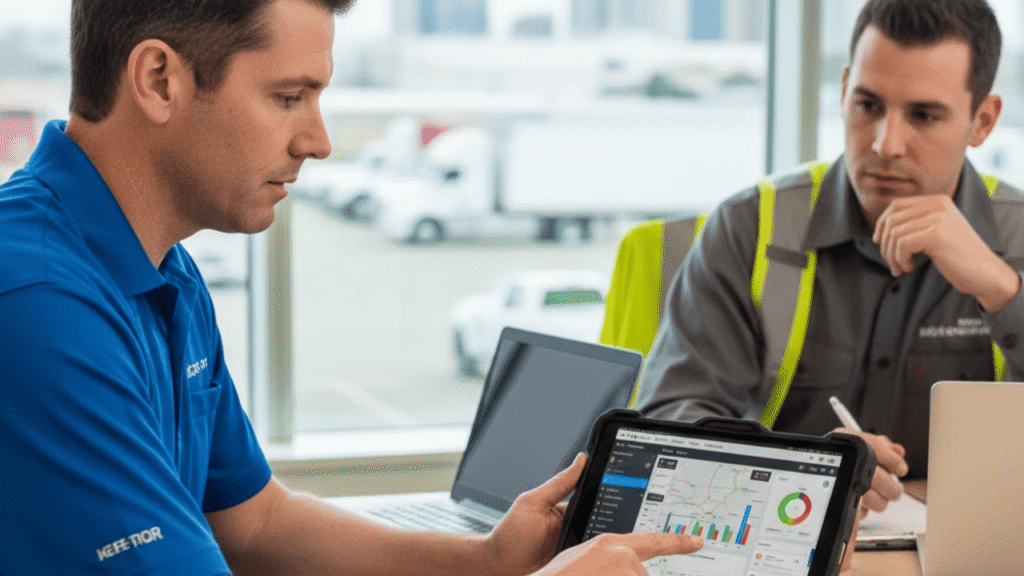
If your goal is to reduce fleet insurance costs with training, focus on what insurers care about most: fewer losses, lower severity, and proof that your fleet manages risk consistently. Training helps you do all three, by preventing crashes, tightening compliance, and building a defensible safety culture that stands up in underwriting and claims.
Commercial auto remains a challenging market, with rising claim frequency/severity and large jury awards frequently cited as pressure points. Training is one of the few levers fleets can control, especially when it’s measured, coached, and reinforced.
Table of Contents
Reduce Fleet Insurance Costs With Training Through Insurance Risk Reduction
Insurers price based on expected risk. Training reduces that risk in ways you can document:
- Fewer preventable crashes through better decision-making and hazard recognition
- Lower claim severity by reducing high-speed impacts and distraction-related events
- Cleaner compliance performance, which supports a stronger safety profile
FMCSA’s CSA/SMS approach is built around using safety performance data to identify carriers with behaviors associated with crash risk. That same “risk signal” mindset shows up in underwriting conversations.
Driver safety program benefits that matter to underwriters
A strong driver program typically improves:
- Speed and following distance discipline
- Backing and yard incident reduction
- Fatigue and distraction controls
- Inspection readiness and documentation habits
The Fewer Claims Strategy: Train What Actually Causes Losses
A practical fewer claims strategy trains the highest-frequency and highest-cost events—not just “general safety.”
Build modules around:
- Rear-end prevention (space management + braking habits)
- Intersection and lane-change risk (mirror routines + blind-spot discipline)
- Backing/low-speed damage (GOAL, setup, spotter communication)
- Cargo/load shift prevention (securement and re-check routines)
- Post-incident steps (photos, reporting, calm documentation)
Crashes are expensive at a societal level and for fleets. FMCSA’s crash cost methodology work highlights how quickly costs add up across injury levels and property damage.
Telematics and Coaching: Turn Data Into Lower Fleet Insurance Premiums
Training works best when it’s reinforced by real-world coaching. That’s where telematics and coaching can change insurance outcomes, because it connects behaviors (hard braking, speeding, distraction) to targeted retraining.
Multiple industry sources report that combining telematics with training/coaching is associated with fewer crashes and/or claims (often cited around 72% of fleets reporting reductions).
Video-based monitoring paired with behavioral coaching has also been studied in commercial fleets, showing meaningful reductions in safety-related events after intervention.
Best practice: coach fast, coach small.
- Weekly micro-coaching (5–10 minutes) beats quarterly “big training days”
- Use short clips and one behavior goal at a time
- Track improvement trends, not just violations
That’s how telematics becomes a premium conversation, not just a gadget.
Related Article: Impact of Non-Compliance on Insurance Premiums
Compliance Training Impact: Fewer Violations, Fewer Headaches
Violations can trigger more scrutiny, downtime, and a perception of weak controls. Compliance training impact shows up when your drivers:
- Log correctly and confidently
- Pass inspections with fewer defects
- Follow written policies consistently
FMCSA’s CSA framework is designed to improve safety and prevent crashes through data-driven monitoring and interventions. Cleaner compliance supports a stronger risk story.
Related Article: How HOS Training Improves Driver Safety
Quick Wins Checklist for Cutting Fleet Insurance Premiums
Use this as a “featured snippet” action list:
- Train new hires on your top 5 loss drivers (rear-end, backing, lane change, fatigue, distraction)
- Add telematics-triggered coaching within 72 hours of a risky event
- Run monthly refreshers (15 minutes) + quarterly ride-along
- Document training completion, coaching notes, and improvement trends
- Standardize post-crash reporting to reduce claim friction and dispute time
Training That Pays for Itself
To reduce fleet insurance costs with training, treat safety like a measurable operating system: train the riskiest scenarios, coach using telematics signals, document improvement, and keep compliance tight. That combination reduces preventable events, strengthens your risk story, and helps you compete for better insurance terms over time.
Improve Safety, Compliance, and Insurance Outcomes
Want help building a training and coaching program that supports safer driving, and better insurance conversations? Reach out to us at www.welocity.ca, call 905-901-1601, or email info@welocity.ca if you need trucking-related services. Whether it is ELD setup, compliance training, or vehicle inspections, we have you covered.