
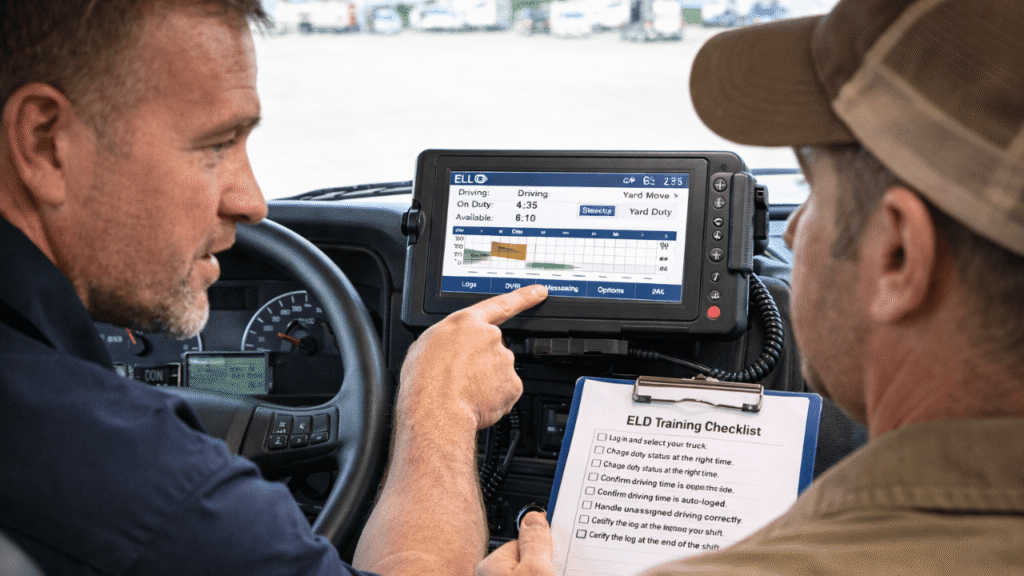
To be honest, most of the resistance to electronic logs doesn’t come from “technology.” It happens when people are confused, when things are rushed, and when rules don’t seem clear at the time. Solid ELD driver training eliminates that friction by showing people exactly what to do, when to do it, and what to avoid, all without turning it into a long, boring lecture.
The best way to do this is to explain why, show how, and go over the parts that people get wrong the most. If you base your rollout on real-life situations, ELD driver training stops being a one-time thing and becomes a habit that keeps your business safe.
Table of Contents
How to Train Truck Drivers on ELD Systems
1) Begin with the “why” in simple terms
Tell everyone what good logs do for them and the company before they touch a screen:
- Fewer delays on the road because logs are clean and consistent
- Fewer fights over stops and timelines
- More accurate records of pay and trips when the data is correct
Make it short. This isn’t a sermon about following the rules. It’s why training for ELD drivers is important.
2) Show the few things that lead to most mistakes
In the first session, talk about the most important things that people will use every day:
- Logging in and choosing the right car
- Changing your duty status at the right time
- Signing off on logs at the end of the shift
- Writing down notes when something strange happens
Then add to that. People forget almost everything when you try to teach them everything at once. ELD driver training becomes “that class we sat through” instead of a useful skill.
3) Use real-life situations to practice, not perfect ones.
Do short role-play exercises that are similar to real work:
- Stop for gas and a quick break
- Being late at a receiver
- Team handoff or trailer change
- Planning for the end-of-day recap
Have everyone do the clicks on their own. It’s not enough to just watch a demo. ELD driver training sticks because you do it over and over again.
4) Make a “day one” and a “week one” standard
Set clear expectations:
- Day one: correct login, correct status changes, and daily certification
- Week one: fewer changes, neater notes, and a quicker routine
This makes ELD driver training more realistic. People get better faster when they know what “good” looks like at every stage.
5) Give someone the job of answering questions.
Pick a calm, respected internal champion (or a small group of them) who always answers questions. When people give different answers, it doesn’t take long for confusion to spread, and your investment in ELD driver training loses steam.
ELD Training Checklist for Fleet Managers
Use this quick checklist to keep your rollout clean and repeatable:
Before rollout
- Confirm user accounts, vehicle lists, and time zone settings
- Decide your company rules for personal use, yard moves, and annotations
- Build a one-page “what to do every day” handout
- Prepare 5 real examples from your lanes (fuel, detention, swaps, breakdowns, inspections)
During rollout
- Keep the first session under 60 minutes
- Demo once, then make everyone practice twice
- Require end-of-shift certification on day one
- Teach the “top 3 mistakes” you see most often and how to prevent them
After rollout
- Review logs after 48 hours and again after 7 days
- Coach in short conversations using one example at a time
- Track edits by terminal or route to find root causes (not blame)
- Refresh monthly with a 10-minute “tip of the week” session
If you follow this list, ELD driver training becomes a process you can repeat for new hires, seasonal volume, or adding new trucks, without reinventing the wheel each time.
Related Article: ELD Audit Checklist
Common ELD Training Mistakes to Avoid
- Treating rollout like a single class instead of a routine
- Skipping hands-on practice and relying on demos
- Letting policy questions stay “gray” (people will guess)
- Waiting too long to coach early errors
The fix is straightforward: keep ELD driver training simple, consistent, and tied to real work. The goal is clean habits, not perfect theory.
Related Article: How to Avoid ELD Mistakes and Keep Logs Clean
Build Confidence First, Accuracy Follows
When people feel confident, they log correctly. That’s why the best ELD driver training focuses on daily actions, real scenarios, and quick coaching loops, especially in the first week. Do that, and you’ll see fewer edits, fewer avoidable issues, and smoother inspections.
Need Help Setting Up ELD Training That Actually Works?
Reach out to us at www.welocity.ca, call 905-901-1601, or email info@welocity.ca if you need any trucking-related services. Whether it is ELD setup, compliance training, or vehicle inspections, we have you covered.