
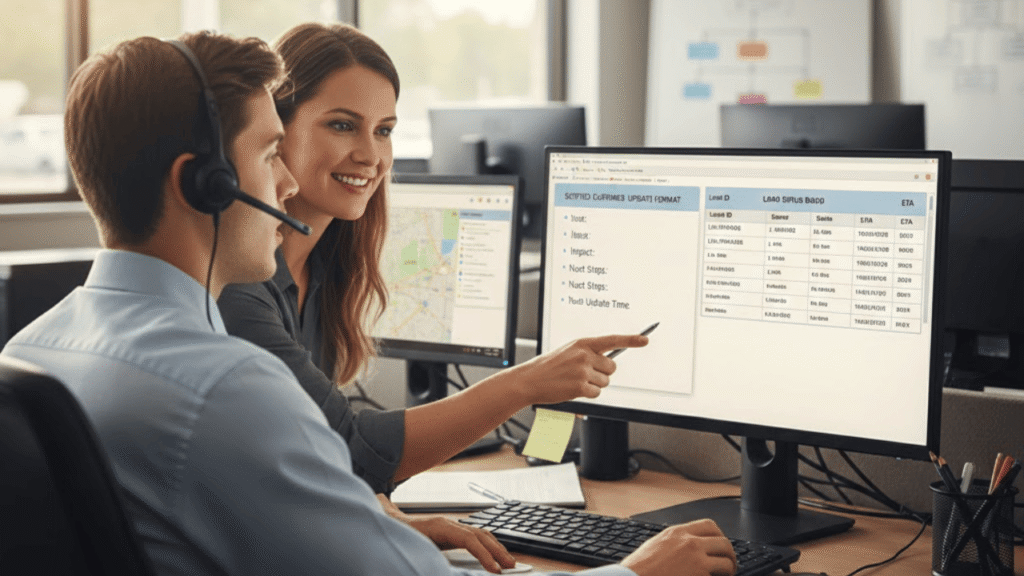
Dispatch training for customer satisfaction isn’t just about “being nice on the phone.” Dispatchers control the customer’s day-to-day experience: accurate ETAs, clear updates, fewer surprises, and faster fixes when something goes wrong. When dispatch is trained like a customer-facing role (because it is), shippers feel informed, respected, and confident, leading to repeat business and fewer complaints.
The best part: you don’t need a complicated program. You need a focused system that improves communication, planning, and recovery.
Table of Contents
Why Dispatch Training Directly Impacts Customer Satisfaction
Customers judge carriers on reliability and responsiveness. Dispatch training improves both by creating consistent habits:
- Fewer late deliveries through smarter load planning and time management
- Better updates with clear, proactive communication
- Faster problem resolution using repeatable service recovery procedures
- More consistent service regardless of which dispatcher is on shift
When service feels predictable, customers relax. When service feels uncertain, every shipment becomes a stress test.
Related Article: How Dispatch Training Increases Fleet Profitability
Dispatcher Communication Training: What to Teach (and why it works)
Strong communication reduces “Where’s my load?” calls and prevents escalations. Training should cover:
Standard communication cadence
Teach dispatchers to update customers at set points:
- Load accepted / driver assigned
- En route to pickup
- Arrived at pickup (with dwell risk notes)
- In transit with refreshed ETA
- Delivered + POD timeline expectations
This consistency builds trust, even if the news isn’t perfect.
Clarity over complexity
Train for short, structured updates:
- What happened (facts only)
- What it means (impact on ETA)
- What we’re doing (next steps)
- When you’ll hear from us again (time-bound follow-up)
Tone and de-escalation skills
Customer service for dispatchers includes:
- Active listening and summarizing
- Neutral language under pressure
- Owning the next action (“I’ll call you by 2:00 PM with an updated ETA.”)
Related Article: Soft Skills for Better Driver-Fleet Communication
On-time Delivery Improvement Starts with Load Planning Training
Late deliveries often begin as small planning gaps. Load planning training improves on-time performance by teaching dispatchers how to build realistic schedules:
- Appointment math (pickup + transit + buffers + breaks)
- Dwell time planning (dock delays, live load/unload expectations)
- Driver-hours awareness (without guessing)
- Weather and route risk planning
- Backup options (swap trailers, repower triggers, alternate pickup windows)
A simple planning checklist (great for SOPs)
- Confirm pickup/delivery appointments and special requirements
- Validate route time plus realistic buffers
- Identify high-risk factors (tight window, long dwell, border delays)
- Set customer update milestones before problems happen
- Document assumptions so another dispatcher can step in seamlessly
Service Recovery Procedures: The Fastest Path Back to Trust
Mistakes and delays happen. The difference is how you respond. Train dispatchers on a repeatable service recovery playbook.
Service recovery SOP (use this as a template)
- Acknowledge the issue quickly (no defensiveness)
- Assess impact (how late, why, what’s controllable)
- Communicate an honest ETA and next update time
- Offer options (reschedule, split delivery, repower, drop trailer)
- Confirm the plan and document it
- Follow up after delivery to close the loop
Customers often forgive delays, but they rarely forgive silence.
What to Measure After Dispatch Training
Training sticks when it’s tied to metrics. Track these weekly or monthly:
- On-time pickup and on-time delivery
- OTIF (On Time In Full) if applicable
- ETA accuracy (planned vs actual arrival)
- Customer complaint rate (by lane, terminal, dispatcher)
- Service recovery time (time from issue to customer update)
- Repeat “status check” calls (a hidden satisfaction signal)
Related Article: How Dispatch Training Improves Load Efficiency
Turn Dispatch Training Into a Customer Advantage
When dispatch teams are trained with clear standards, communication cadence, load planning discipline, and strong service recovery procedures, customers feel informed and supported. That’s how dispatch training for customer satisfaction turns into fewer complaints, better retention, and a stronger reputation.
Need Help Improving Dispatch Performance and Customer Service?
Reach out to us at www.welocity.ca, call 905-901-1601, or email info@welocity.ca if you need trucking-related services. Whether it’s compliance training, dispatcher SOPs, onboarding support, ELD setup, or vehicle inspections, we have you covered.