
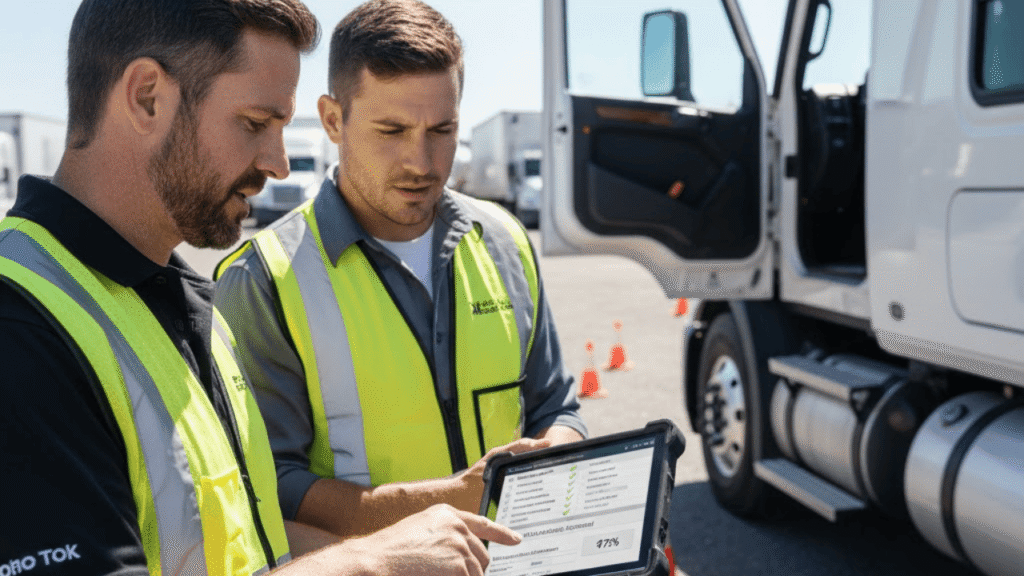
To choose a trucking training provider that actually improves safety and performance, you need more than a polished slide deck. The right partner helps you standardize coaching, prove competency, and maintain records that hold up in audits, without pulling drivers off the road longer than necessary.
Table of Contents
Start with your training goals (and what “success” means)
Before you compare vendors, define what you’re trying to improve:
- On-time delivery improvement (planning, communication, delay prevention)
- Fewer preventables (backing, speed management, space management)
- Better roadside results (inspection routines, securement, DVIR habits)
- Reduced log/ELD issues (HOS understanding, auditing, coaching)
Then decide how you’ll measure success:
- On-time %, preventable rate, inspection violations, claims, customer complaints
- Skills check pass rates, retraining triggers, repeat issues per driver
Related Article: Understanding HOS Violations Penalties
Compliance must-haves: don’t skip this step
If you operate in the U.S. and need entry-level CDL training, confirm the provider is eligible and properly listed. FMCSA’s ELDT rules set baseline requirements for entry-level drivers and certain endorsements.
What to verify:
- Provider is listed on the FMCSA Training Provider Registry (TPR) for ELDT-related training.
- Provider understands ongoing listing requirements and can produce documentation if audited.
- Training certifications are submitted promptly (TPR guidance notes submissions by midnight of the second business day after completion).
If you operate in Canada, align training to carrier expectations shaped by the National Safety Code (NSC) standards (a set of 16 standards that influence provincial/territorial oversight).
Fleet training vendor checklist (copy/paste)
Use this checklist when comparing fleet management books-style theory vendors vs. hands-on trucking trainers.
1) Instructor qualifications
- Proven trucking operations experience (equipment + lanes like yours)
- Demonstrated coaching ability (not just “industry knowledge”)
- Clear evaluation method (skills-based sign-off, not attendance-based)
- References from fleets similar in size and risk profile
2) Curriculum fit (your operation, not generic content)
- Role-based modules (new hire, experienced hire, mentor, dispatch)
- Equipment-specific training (reefer/flatbed/tanker/yard)
- Customer procedures and service expectations
- Options for micro-training and refresher cadence
3) Proof of competency
Ask: “How do you verify a driver can do the skill?”
- Pre-trip and inspection routine verification
- Backing/coupling/securement demonstrations
- Road evaluation checklist with pass/fail standards
4) Training documentation requirements (audit-ready)
- Attendance + topic outline + instructor name
- Test results and skills checklists
- Coaching notes tied to retraining triggers
- Record storage guidance (retention, access control, versioning)
5) Delivery model and scheduling reality
- Online + in-yard + ride-along options
- Minimal disruption plan (shift-friendly scheduling)
- Trainer-to-driver ratios and maximum class size
6) Reporting and continuous improvement
- Monthly metrics summary (completion, pass rates, repeat issues)
- Recommendations tied to real trends (incidents, violations, claims)
- A process for updating materials when issues change
What to ask during trucking training provider evaluation
These questions expose whether the vendor can deliver results:
- “Show me your skills checklists and scoring rubric.”
- “How do you handle inconsistent coaching across terminals?” (standardization plan)
- “What does your onboarding and retraining policy look like in practice?”
- “How do you document service recovery procedures and customer communications?”
- “What’s your plan for refresher training and triggered retraining?”
- “How do you support compliance requirements for our jurisdiction?” (ELDT/TPR, NSC alignment)
Red flags to watch for
- Guarantees with no measurement plan (“we’ll reduce accidents by 50%”)
- No skills verification (only lectures and certificates)
- Vague instructor bios or heavy subcontracting without oversight
- Weak documentation process (“we can send a spreadsheet later”)
- One-size-fits-all content that ignores your freight, customers, and equipment
Choose a Trucking Training Provider That Delivers Measurable Results
The fastest way to choose a trucking training provider is to treat it like a safety-critical purchase: confirm compliance fit, validate instructor qualifications, require skills verification, and demand clean documentation. When the provider can prove competency and track outcomes, training becomes a performance tool, not a checkbox.
Need Help Vetting Training Providers and Building a Strong Fleet Program?
Reach out to us at www.welocity.ca, call 905-901-1601, or email info@welocity.ca if you need trucking-related services. Whether it’s compliance training services, onboarding support, ELD setup, or vehicle inspections, we have you covered.