
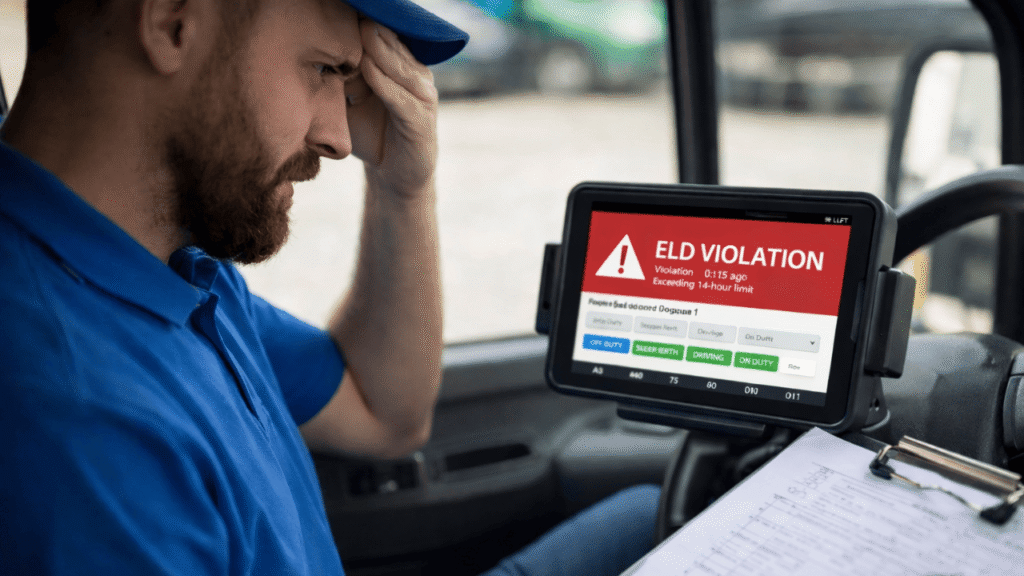
An ELD violation can seem to come out of nowhere, especially when the driver says everything was fine. But here’s the thing: one ELD violation doesn’t mean your fleet is bad. What matters is what you do next, how quickly you make things clearer, and whether you can stop the same problem from happening again.
Table of Contents
Violation Code
First, get specific. Don’t settle for “we got dinged for ELD.” Pull the inspection report and identify the exact violation code and any officer notes. Then compare it to what your ELD shows for that same time window.
This matters because not every ELD violation is the same. Some are recordkeeping issues (missing certifications, missing information), while others relate to device problems (such as transfer issues) or HOS compliance. Your fix depends on the type.
Related Article: How to Interpret ELD Violations Without Panicking
Log Corrections
Once you know what went wrong, you can make legitimate log corrections, but only the right way. FMCSA allows limited edits to correct mistakes or add missing information, and every change needs an annotation explaining why. Also, the driver must confirm/certify carrier edits and resubmit the record.
Quick rule of thumb: fix errors, don’t “rewrite the day.” A clean correction process makes a future review much easier if this ELD violation ever gets questioned again.
Related Article: How to Avoid ELD Mistakes and Keep Logs Clean
Documentation Proof
If there’s one step fleets skip too often, it’s gathering documentation proof. This is where you support the story of the day with real records, dispatch messages, appointment times, bills of lading, fuel receipts, scale tickets, and anything else that explains the timeline.
Suppose the ELD violation was tied to a malfunction or diagnostic issue, document that immediately. FMCSA requires the driver to notify the carrier within 24 hours, and the carrier generally has 8 days to repair/replace the ELD. If the device can’t accurately record or display HOS, the driver needs to use paper logs during that window.
Driver Coaching
After you handle the paperwork, talk to the driver so the same ELD violation doesn’t happen again next week.
Keep it simple:
- “Here’s what enforcement cited.”
- “Here’s what the ELD shows.”
- “Walk me through what happened.”
Most of the time, coaching is about one of these things: the driver didn’t understand a feature (like certifying logs, handling edits, or special statuses), they were in a hurry, or they felt like they had to “make it work.” The best coaching is hands-on: you have one clear goal and then a quick review.
Carrier Response
Now zoom out. Your carrier response should be consistent every time, not improvised. Create a short internal record that shows:
- What the ELD violation was
- What you reviewed
- What you corrected (if anything)
- What proof do you collect?
- What coaching or process change do you apply?
Also, remember that if electronic transfer fails, FMCSA guidance explains that drivers may still be compliant if they can show the records on the ELD display or provide a printout, so training drivers on “showing the logs” matters just as much as transfer steps.
Steps To Take After Receiving An ELD Violation
Here’s a simple checklist you can follow every time:
- Pull the inspection report and identify the details of the ELD violation.
- Match the violation to the ELD records for that period.
- Apply allowed edits with notes, then have the driver confirm and recertify.
- Collect supporting documents to back up the timeline.
- Coach the driver while the trip is still fresh.
- Track whether this is a one-off or a trend across drivers/terminals.
If you do this consistently, one ELD violation becomes a quick fix, not a lingering problem.
How To Respond To ELD Violation Codes After Inspection
When you’re figuring out how to respond, avoid the two extremes: ignoring it or overreacting. The smartest approach is “verify, document, correct, coach.”
And don’t forget the bigger compliance picture: carriers are responsible for using only ELDs on FMCSA’s registered list, and that’s something that enforcement and auditors can look at if device issues keep showing up.
Handled the right way, an ELD violation becomes a signal that improves your process, rather than a hit you keep taking.
Get Your Fleet Back to Clean Logs
An ELD violation is annoying, but it’s also useful information. Treat it like a process check: clean up the record, gather your proof, coach quickly, and tighten the system. Do that, and you’ll see fewer repeat issues, and a lot less stress the next time an inspection happens.
Need Help Fixing ELD Violations and Getting Inspection-Ready?
Reach out to us at www.welocity.ca, call 905-901-1601, or email info@welocity.ca if you need any trucking-related services. Whether it’s ELD support, compliance coaching, or inspection readiness, we have you covered.