
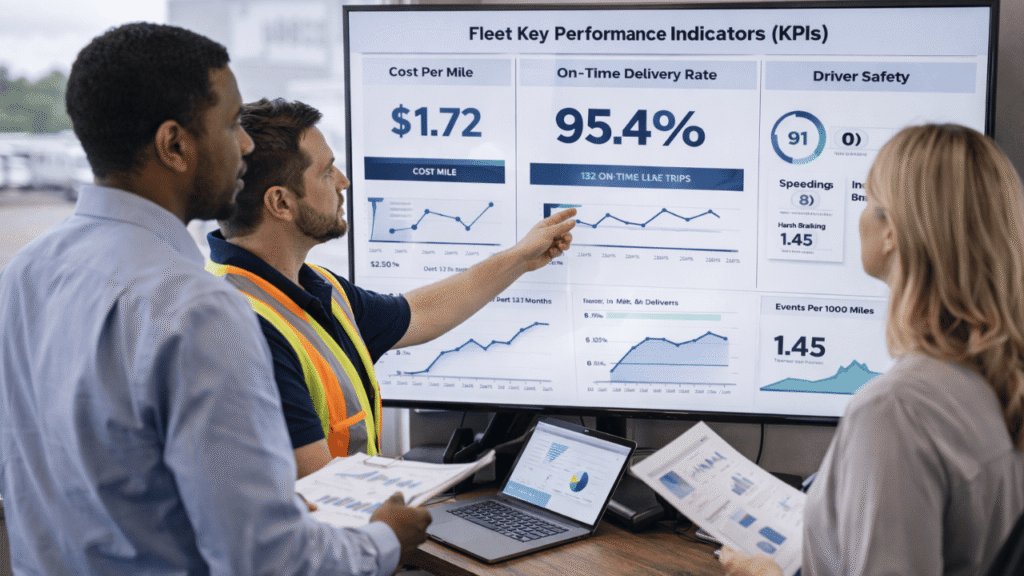
If you manage trucks, drivers, and tight schedules, understanding fleet KPIs isn’t optional, it’s how you keep operations under control. The right fleet KPIs, trucking KPIs, and fleet performance metrics show you what’s really happening day to day, so you can spot hidden costs, reduce downtime, improve service levels, and strengthen driver safety before small issues turn into expensive ones.
Table of Contents
Fleet KPIs to Track for Profitability and Efficiency
Cost per Mile (CPM)
Cost per mile is a key fleet performance metric because it connects every decision to your bottom line.
Formula:
CPM = Total operating costs ÷ Total miles driven
Track CPM by category to pinpoint where costs are rising:
- Fuel (including idle time)
- Maintenance and tires
- Driver wages and benefits
- Insurance
- Tolls and permits
Real-world example: If your CPM For example, if your CPM rises in winter, it could be due to excess idling, more breakdowns, or poor route planning, rather than just seasonal costs rate shows how effectively assets are working versus sitting.
Common approach:
Utilization rate = Loaded miles ÷ Total miles (or revenue hours ÷ available hours)
High utilization does not always mean high profit, so review it alongside CPM and revenue per mile.
Related Article: How Dispatch Training Increases Fleet Profitability
Revenue per Mile (RPM)
RPM shows whether you are pricing your routes correctly.
Formula:
RPM = Total revenue ÷ Total miles
If RPM increases and CPM stays the same, your margins get better. If RPM is steady but CPMrises, review your fuel, maintenance, and detention costs.
Trucking KPIs for Service Quality and Customer Trust
On-Time Delivery Rate (OTD)
On-time delivery rate is a key measure of your reliability.
Formula:
OTD = On-time deliveries ÷ Total deliveries × 100
Improve OTD by tracking:
- Dispatch planning accuracy
- Traffic/route strategy
- Driver hours-of-service constraints
- Dock delays (detention and dwell time)
Dwell Time and Detention
These metrics often reveal why OTD drops or CPM increases.
Track:
- Average dwell time per facility
- Detention hours per load
- Top 10 delay locations (for shipper conversations)
Driver Safety Metrics That Reduce Risk and Claims
Driver Safety Metrics
Good driver safety metrics help protect your team, your equipment, and your insurance rates.
Common safety KPIs:
- Preventable incident rate
- Speeding events per 1,000 miles
- Harsh braking/acceleration events
- Hours-of-service violations
- Following distance alerts (if using camera/telematics)
Use coaching that iCoach drivers consistently and keep good records. Aim to reduce risky behaviors while making sure drivers feel valued.
Maintenance KPI Tracking
Small mistakes in maintenance can cause costly breakdowns. Tracking maintenance KPIs helps keep your trucks on the road and in compliance.
Key maintenance KPIs:
- Preventive maintenance (PM) compliance rate
- Breakdown rate (per 10,000 miles)
- Mean time between failures (MTBF)
- Mean time to repair (MTTR)
- Out-of-service events and reasons
How to Build a Simple Fleet KPI Dashboard
Begin with six to eight KPIs that you can use to make real improvements:
- Cost per mile
- Utilization rate
- On-time delivery rate
- Fuel economy + idle percentage
- Driver safety metrics (top 3 behaviors)
- Maintenance KPI tracking (PM compliance A schedule that works:
- Weekly: safety, OTD, utilization, idle time
- Monthly: CPM, RPM, maintenance trends, downtime
Understanding Fleet KPIs for Consistent Performance
Tracking fleet KPIs matters most when you use the numbers to take action. Focus on a few key trucking KPIs, like cost per mile, utilization rate, on-time delivery rate, driver safety, and maintenance tracking. Review them on a schedule your team can keep up with. Over time, these metrics will help you run safer operations, avoid surprises, and improve your margins.
Want a Clearer KPI System for Your Fleet?
Reach out at www.welocity.ca, call 905-901-1601, or email info@welocity.ca for help with your trucking needs. Whether you need ELD setup, compliance training, or vehicle inspections, we can help you turn KPI tracking into real improvements.