
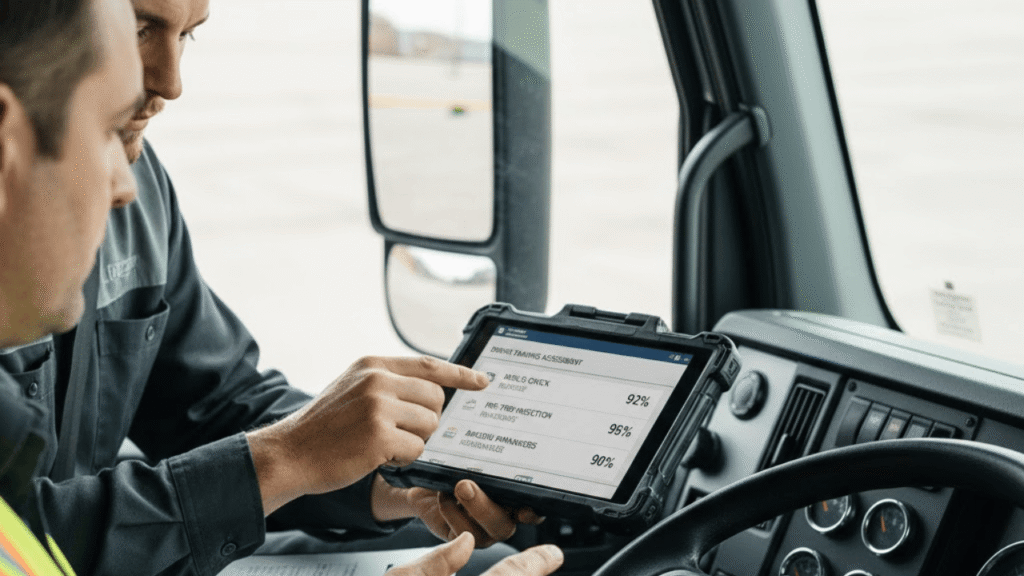
If you run a fleet, you already know training matters, but proving it works is where many programs fall short. To measure driver training effectiveness, you need more than “attendance” or “test scores.” You need a simple system that connects training to real-world outcomes like fewer incidents, better inspections, and stronger on-road behaviors.
Table of Contents
Measure Driver Training Effectiveness With a 3-Layer Framework
The most reliable approach combines three layers:
- Learning: Did drivers understand the material?
- Behavior: Did driving habits change on the road?
- Results: Did safety and cost outcomes improve?
This keeps your evaluation balanced, because a driver can pass a quiz and still keep risky habits.
Key Training KPIs for Fleets to Track
Choose KPIs that match your training goals (safety, compliance, fuel, customer service). Start with a core set and expand as you mature.
Safety performance metrics (high impact)
Track trends before and after training (e.g., 30/60/90 days):
- Preventable collisions per million miles
- Near-miss events (from telematics or dashcam review)
- Speeding frequency and severity
- Harsh braking/acceleration and cornering events
- Following distance or time-headway violations
- Seatbelt usage rates
- Distracted driving flags (where measured)
Compliance and inspection metrics
If training includes compliance, measure outcomes like:
- Roadside inspection pass rate
- Out-of-service rates (driver/vehicle)
- Log/ELD violations and form-and-manner issues
- Hours-of-service exceptions or recurring patterns
Operational quality metrics (optional but useful)
Depending on training scope, also consider:
- Cargo claims and load securement issues
- Late deliveries tied to unsafe driving behaviors
- Customer complaints related to driving or professionalism
Post-Training Assessments That Actually Predict Performance
Quizzes are useful, but only if you combine them with scenario-based checks.
Better post-training assessments include:
- Scenario questions: “What do you do when…” situations drivers face daily
- Video-based judgments: identify hazards, safe following distance, lane discipline
- Ride-alongs or virtual ride reviews: short, structured observations
- Skills validations: coupling/uncoupling, pre-trip inspections, securement checks
Featured snippet-style checklist:
A strong post-training assessment should measure (1) knowledge, (2) decision-making, and (3) real behavior within 2–4 weeks.
Coaching Scorecards: The Missing Link Between Training and Change
Training alone rarely changes habits. Coaching does, especially when it’s consistent and trackable.
Build a coaching scorecard with:
- 5–7 behaviors that match your training module (e.g., speeding, following distance)
- A simple scale (e.g., 1–5) with clear definitions
- Space for coaching notes and driver commitments
- A review cadence (weekly for high-risk drivers, monthly for others)
What to include on coaching scorecards
- Leading indicators: telematics events, video tags, observation outcomes
- Lagging indicators: incidents, violations, claims
- Action plan: “What I’ll do differently next week” (driver-owned)
This turns training into a repeatable improvement cycle.
Training ROI Measurement: How to Show the Business Value
To calculate training ROI measurement, keep it simple and defensible.
Step-by-step training ROI (basic method)
- Define costs: training time, instructor cost, platform fees, admin time
- Define measurable outcomes: reduced collisions, fewer violations, lower claims, less downtime
- Assign values: average collision/claim cost, cost per violation, cost per day out of service
- Compare before vs. after: use a baseline period (e.g., prior 90 days)
- Calculate ROI:
- ROI % = (Benefits – Costs) / Costs × 100
Real-world example: If coaching + training reduces preventable incidents and saves more in claims/downtime than it costs to run, you can show a clear ROI even without perfect data.
Common Mistakes That Make Results Look Worse Than They Are
Avoid these traps when you measure driver training effectiveness:
- Tracking only one metric (like collisions) and ignoring leading indicators
- Measuring too soon (behavior change often shows in 30–90 days)
- Not segmenting drivers (new hires vs. veterans vs. high-risk group)
- Failing to reinforce training with coaching and refreshers
- Using raw totals instead of rates (per mile/per trip)
Proving You Measure Driver Training Effectiveness
To measure driver training effectiveness, track learning, behavior, and results together. Use a small set of training KPIs for fleets, pair them with post-training assessments, and reinforce change through coaching scorecards. Finally, tie improvements to dollars saved with straightforward training ROI measurement. When you measure the right things, training stops being a cost, and becomes a safety and performance engine.
Get Your Fleet Training Results on Track
Need help building scorecards, improving compliance, or connecting training to real safety outcomes? Reach out to us at www.welocity.ca, call 905-901-1601, or email info@welocity.ca. Whether it’s ELD setup, compliance training, or vehicle inspections, we’ve got you covered.