
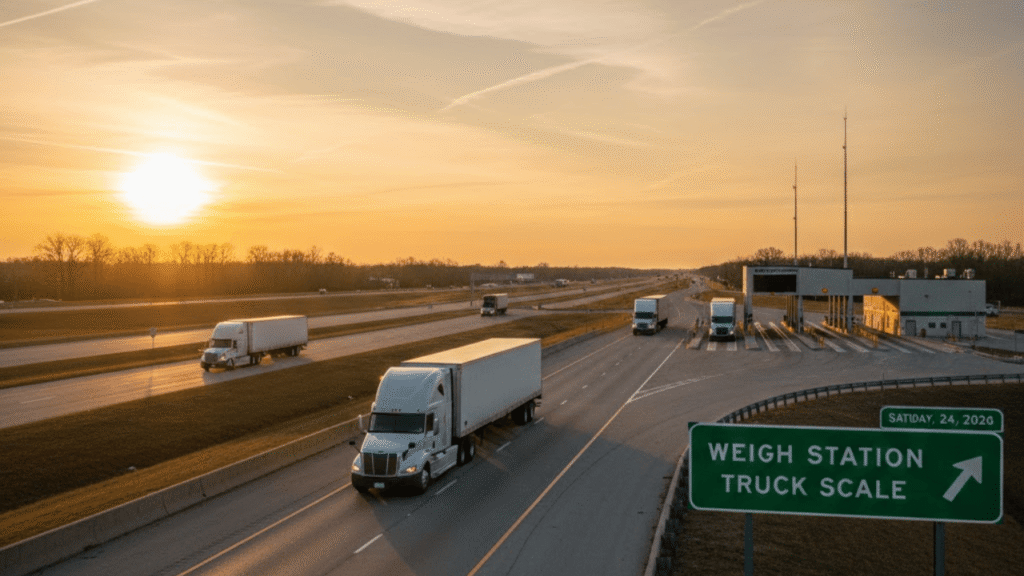
Cross-border freight gets complicated fast because truck weight and dimension limits Canada US aren’t governed by one single rulebook. Canada uses provincial/territorial rules that are often aligned through an interprovincial MOU, while the U.S. applies federal standards on the Interstate/National Network, plus state-specific rules off those routes.
Table of Contents
Truck Weight and Dimension Limits Canada US: What’s “Standard” vs Local
Think of “standard” limits as the baseline for major routes, and “local” limits as what applies on specific roads, cities, or secondary highways.
- Canada: Provinces/territories set enforceable limits, often harmonized through the federal/provincial/territorial Memorandum of Understanding (MOU) for interprovincial operations.
- United States: Federal rules set baseline weights and width on the National Network/Interstate System, with state rules and permits layered on top.
Quick Reference: Common Commercial Vehicle Size Limits
Use this as a fast screening tool (always verify by route and jurisdiction).
Canada (common MOU baseline for tractor–semitrailer)
Typical maximums shown in MOU summary for a standard tractor–semitrailer include:
- Overall width: 2.6 m
- Overall height: 4.15 m
- Overall length (tractor–semitrailer): 23 m
United States (National Network / Interstate baseline)
- Width: 102 inches (≈ 2.6 m) on the National Network (Hawaii has a specific exception).
Note: Height is largely state-controlled in the U.S. (many states commonly allow 13’6″, but it’s not a single federal standard everywhere). Keep height checks route-specific.
Axle Weight Limits and Legal Gross Vehicle Weight
U.S. federal weight limits (Interstate/National Network)
Federal baseline limits are:
- Single axle: 20,000 lb
- Tandem axles: 34,000 lb
- Gross vehicle weight: 80,000 lb (unless the bridge formula requires less)
Canada axle limits: configuration matters
In Canada, allowable weights depend heavily on:
- Axle group type (single/tandem/tridem)
- Axle spacing and load equalization
- Tire ratings and tire width limits (the MOU summary references tire-width-based limits, e.g., 10 kg/mm of tire width in its conditions)
Also, watch for seasonal (spring thaw) restrictions, which can temporarily lower allowable weights on certain roads.
Bridge Formula Weight Limits: The “Spacing” Rule in the U.S.
Even if you’re under 80,000 lb, axle spacing can still make you overweight on a specific axle group. That’s where the Federal Bridge Formula comes in, it limits weight based on:
- Number of axles in a group
- Distance between the first and last axle in that group
Related Article: HOS Rules Canada vs US: Differences Explained
Oversize Permit Requirements: When You Need a Permit
In both Canada and the U.S., you typically need an oversize/overweight permit when you exceed legal limits, especially for non-divisible loads (loads that can’t be reasonably broken down). Federal definitions and permit logic commonly reference “nondivisible” criteria.
Featured-snippet checklist: common permit triggers
You’ll usually need permits when any of these are true:
- Over legal width, height, or length
- Over legal axle weight limits or legal gross vehicle weight
- Your route includes restricted bridges/roads
- You require escorts, route surveys, or travel-time restrictions
What permit applications usually require
- Exact dimensions (overall and axle spacings)
- Accurate weights by axle group
- Commodity type (divisible vs non-divisible)
- Proposed route + origin/destination
- Safety measures (signage, lighting, escorts)
Practical Compliance Tips for Dispatch and Drivers
- Build route-based checks: legal on one highway doesn’t mean legal on the next (especially off-network roads).
- Standardize scale tickets: include axle group weights, not just gross.
- Train on “where” rules apply: U.S. Interstate/National Network vs state roads; Canada provincial primary routes vs secondary roads.
- Keep a permit playbook: who applies, cutoff times, escort rules, and after-hours restrictions.
Stay Legal, Protect Your CSA/Safety Score, and Avoid Costly Delays
Getting truck weight and dimension limits Canada US right is about more than avoiding tickets, it prevents out-of-service orders, route detours, and expensive rework at the shipper. Build a repeatable process: confirm axle weights, confirm axle spacing, confirm route rules, then lock permits in early when needed.
Need Help Keeping Your Fleet Compliant Across Canada and the U.S.?
Reach out to us at www.welocity.ca, call 905-901-1601, or email info@welocity.ca if you need trucking-related services. Whether it’s compliance training, ELD support, documentation best practices, or inspection readiness, we have you covered.