
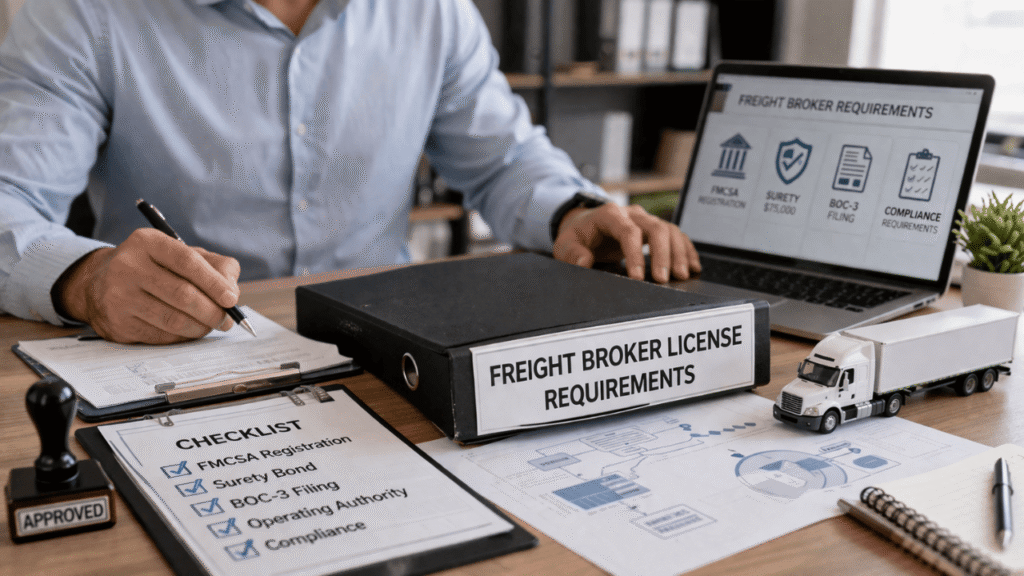
You don’t need a truck to start a successful trucking business. Freight brokers help shippers find carriers, get paid a commission on each load, and run their whole business from a laptop. But before you book your first load, you need to know the freight broker license requirements and ensure you have the right authority.
It’s against the law to run a business without a license. The good news is that the process is easy once you know what to do. Here’s a clear list of all the requirements for a freight broker license that you need to meet before you can legally work in the United States.
Table of Contents
What Is a Freight Broker License?
A freight broker license, also known as “broker authority,” is the legal permission you need to arrange the transportation of goods for money. A freight broker helps move goods by acting as a go-between for shippers and carriers. Brokers need a Federal Motor Carrier Safety Administration (FMCSA) permit to operate legally. This means getting a Motor Carrier number, getting a surety bond, and meeting other federal requirements.
You can’t legally arrange or negotiate freight transportation in the US without this license. You must do all of the steps below.
How to Get a Freight Broker License
Step 1: Choose Your Business Structure
Before you send anything to the FMCSA, you need to decide how to run your business. You can choose between three types of business structures for your freight broker license: a sole proprietorship, a partnership, or a corporation.
The liability protection that an LLC offers is why most new brokers choose it. You need to register your business with the state, get an EIN from the IRS, and open a business bank account. This base makes the rest of the process go more smoothly.
Step 2: Apply for Your FMCSA License
This is the most important part of getting a freight broker license. Fill out Form OP-1 and pay the application fee to the FMCSA to get your freight broker authority. The fee is $300 for each type of authority as of 2025. Applicants must also use the FMCSA Unified Registration System to prove their identity. This means uploading a photo and a government-issued ID for verification.
It will take 4 to 6 weeks for the FMCSA to process your application once you submit it. You will receive an email when your request is approved, and you can check its status online at any time.
Note an important 2025 update: By October 2025, the FMCSA will stop issuing separate MC numbers to brokers and carriers and switch everyone to a single USDOT number system. Instead of an MC number, brokers will use a USDOT number with a broker designation. This change is meant to reduce identity theft and double brokering.
Step 3: Get Your $75,000 Surety Bond
This is a part of the freight broker license requirements that can’t be changed. For property brokers, proof of insurance coverage is needed. This can be a Surety Bond (Form BMC-84) or a Trust Fund Agreement (Form BMC-85) for $75,000.
If you don’t pay or break a contract, the surety bond protects shippers and carriers. You don’t have to pay $75,000 up front; instead, you pay an annual premium to a surety company. Depending on your credit score and your financial situation, BMC-84 premiums can cost anywhere from $750 to $9,000 a year. Most of the time, the BMC-84 bond doesn’t need any collateral.
Also, there is an important update to the compliance requirements: the FMCSA announced new financial responsibility rules in January 2024. By the compliance deadline of January 16, 2026, freight forwarders and brokers must use a BMC-84 surety bond or establish a BMC-85 trust with qualifying assets and a federally insured trustee. Check whether your bond structure meets this new standard.
Step 4: File Your BOC-3 Form
Many new brokers forget about the BOC-3 form until it slows down their application process. It is an important part of setting up your brokerage. This form names a process agent in every state where you want to do business.
You need to get a processing agent in each state where your brokerage will do business. This person will be able to serve papers if someone files a claim against your brokerage in that state.
The freight broker must complete and submit Form BOC-3 to the FMCSA, regardless of how many process agents are hired. The form must list all the states where agent designations are needed, and you must keep a copy at your business.
Most new brokers find it easiest to hire a commercial company that provides process agents in all states for a reasonable annual fee.
Step 5: Register With Unified Carrier Registration (UCR)
The last step in obtaining a license is to register with the Unified Carrier Registration. This agreement sets the rules for how brokers collect and share registration and financial responsibility information, and pay fees.
Every year, you have to register with UCR, and the fees depend on the size of your fleet. This is usually the lowest fee level for a broker without any cars.
Related Article: How to Start a Freight Brokerage Business in Canada and USA
Do You Need Insurance?
The FMCSA does not legally require freight brokers to have liability insurance, but they do need it. But many new freight brokers who buy only the bare minimum of insurance quickly find they can’t work with bigger shippers.
Most serious shippers won’t work with you unless you have contingent cargo liability insurance. Get it from the start; it keeps your options open and protects your business.
Do You Need Training?
You don’t have to go to school to get a freight broker license, but training is highly recommended. Taking part in a formal freight broker training program will teach you important skills like logistics, operations, negotiation, and compliance. These skills will directly impact how quickly you can make your business profitable.
Many successful brokers start as freight agents at a well-known brokerage before going out on their own. That real-world experience is worth more than any course by itself.
How Long Does the Process Take?
The process usually takes 4–6 weeks from the time you apply to when you receive active authority. However, careful planning and paying attention to detail can help you avoid delays.
Missing bond filings, incomplete applications, or BOC-3 mistakes are the most common causes of delays. If you get everything right the first time, you’ll have your FMCSA license active well within that time frame.
Start Your Brokerage on Solid Ground
Knowing what you need to do to get a freight broker license before you apply will save you time, money, and stress. It’s not hard; you have to do the right things in the right order.
Set up your business structure, file your OP-1 with the FMCSA, obtain your $75,000 surety bond, submit your BOC-3, and sign up with UCR. If you do those five things, you’ll have everything you need to work as a freight broker in the US legally.
After that, it’s all about getting to know your carriers, getting your first shippers, and growing one load at a time.
Are you ready to start your brokerage the right way?
Go to Visit Welocity.ca, call +1 (905) 901-1601, or email info@welocity.ca to find resources and opportunities in the freight industry that will help you start and grow your brokerage with confidence.